About Us
Re-Evolution was created out of passion.
Some people love coal, others support gas — and we love the wind… in turbine blades and in our hair.
When photovoltaic panels generate too little solar energy due to unstable weather or cloudy winter days, a wind power plant comes to the rescue. In our climate the wind is always present… sometimes weaker, sometimes stronger.
Needs create ideas — and that is exactly how our company was born.
A real need inspired us to share our passion and experience and to help build your energy independence at the lowest possible cost.
There is no need to rely solely on solutions from large corporations — you can benefit from effective solutions created by true enthusiasts of renewable energy.
Welcome.
Residential Wind Turbines – Are They Worth It?
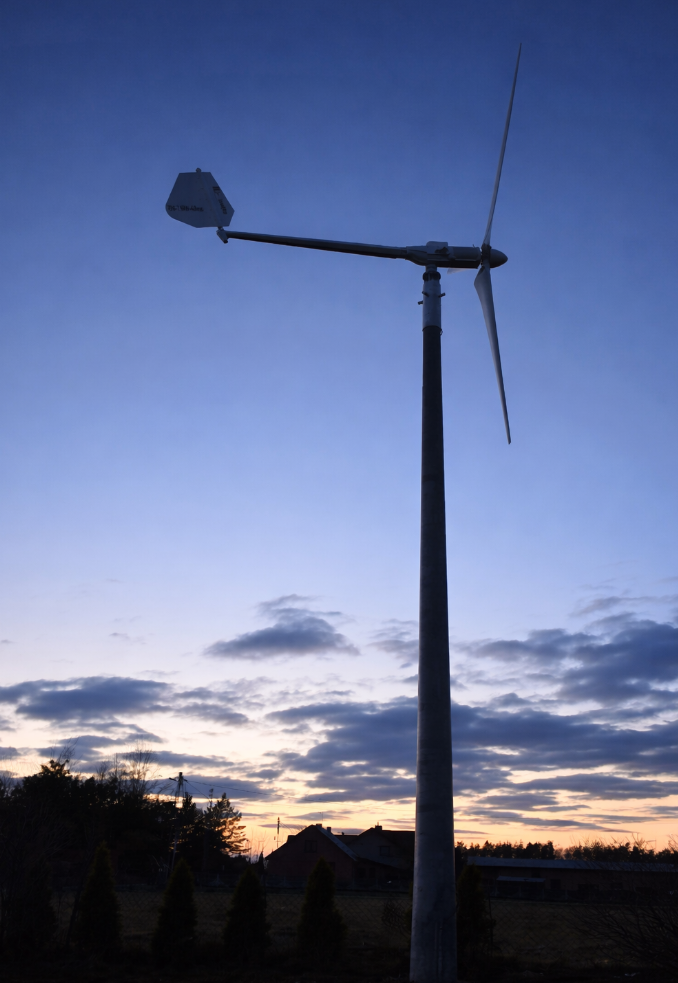
Although small-scale residential wind systems are still not among the most common solutions, wind power has been used around the world for centuries. As early as the Middle Ages, windmills were used to grind grain. Today, this technology is returning in a modern form as a practical alternative to traditional energy sources.
Our goal is to reintroduce wind energy as a simple and cost-effective way to generate electricity for households.
Types of Wind Turbines – Horizontal vs Vertical
Residential wind turbines can be divided into two main types:
- horizontal-axis turbines
- vertical-axis turbines
Horizontal turbines are characterized by high efficiency, reaching around 44%. This is more than 2.5 times higher than vertical turbines, which typically achieve around 16%.
Vertical turbines, on the other hand, offer different advantages – they are significantly quieter and perform better in built-up areas. Thanks to their design, they can operate in changing wind directions, making them a good solution for urban environments.
Wind Turbine vs Solar Panels – Efficiency Comparison
For comparison, photovoltaic systems currently achieve efficiency levels of around 21–22%. In theory, this means that a 3 kW wind turbine can generate up to approximately twice as much energy as a photovoltaic system of the same capacity.
In practice, however, everything depends on local conditions, especially wind availability. A 2:1 ratio is only achievable under the assumption that wind speeds of around 12 m/s occur as frequently as peak sunlight conditions at midday—which is relatively uncommon.
Wind Turbine Installation – What Affects Performance and Noise?
The performance and comfort of using a wind turbine are strongly influenced by the installation method.
The most common noise-related issues result from using a mast that is not rigid enough. In such cases, the turbine may enter resonance, causing vibrations and a characteristic rattling of the blades. Long-term vibrations can lead to wear and even damage to the bearings.
A natural phenomenon is also the “whooshing” sound of blades in strong winds. However, this is usually not bothersome, as it is typically masked by ambient wind noise.
Regulations 2026 – Is a Permit Required?
The rules for installing residential wind systems are governed by building regulations effective from January 2026.
Key points:
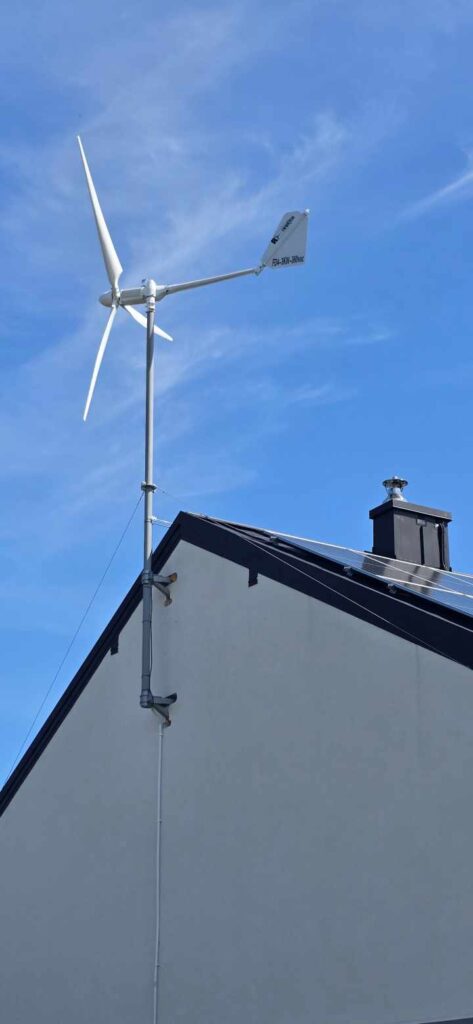
- if the mast does not exceed 3 meters above the highest point of the building (e.g., chimney), no notification or permit is required
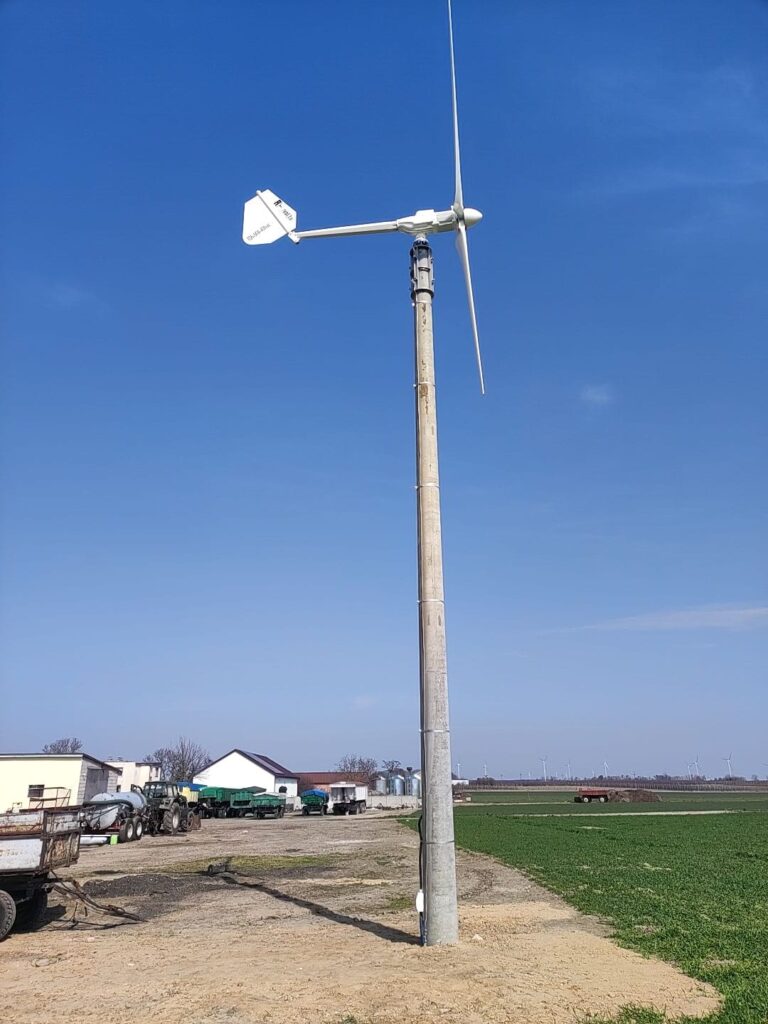
- if the mast is installed on the property (e.g., up to 12 m in height), it must be located at least 12 meters from the property boundary
- in some cases, only a construction notification is required
Benefits of a Residential Wind System
Key advantages of installing a wind turbine:
- high efficiency (especially for horizontal-axis turbines)
- energy generation 24/7
- up to 70% of energy production occurs between October and March
- stable performance throughout its lifespan
- lifespan of 15–20 years
This is particularly important, as energy demand is highest during the autumn and winter months.
Our Offer – Wind Turbines for Homes
We offer modern wind turbines with capacities of:
2 kW, 3 kW, 4 kW, 5 kW, 7.5 kW, and 10 kW
- 2–4 kW models can be mounted directly on a building
- 5–10 kW models require installation on dedicated masts
We provide complete systems, including:
- wind turbine
- mast
- controller
- braking system
- inverter designed for wind turbines
- energy storage
The system can be expanded with a photovoltaic installation and a generator, creating a fully independent off-grid system. This means no electricity bills and full energy independence.
Turbine Optimization – Why It Matters
We operate our own laboratory, where we integrate all system components: the turbine, controller, and inverter.
A key element is matching the turbine’s power curve, which is programmed into the inverter. This ensures the turbine operates within its optimal speed range and achieves maximum efficiency.
It is worth noting that using a standard photovoltaic inverter can reduce turbine performance by up to approximately 25%. This is because such devices tend to limit turbine operation too early, instead of allowing it to reach optimal performance parameters.
We offer:

Residential Wind Turbines

Hybrid Inverters designed to support wind turbines
Energy Storage Systems of various capacities and classes
Solar Power Systems
All of the above solutions are individually tailored to the needs of your home and adapted to your financial capabilities.
Contact:
-
Re-evolution Sp. z o.o.
ul. Św. Michała 100/6
61-005 Poznań - +45 50 10 59 72
- contact@re-evolution.pl