
Q&A
1. Can a standard photovoltaic inverter be connected to a residential wind turbine?
It will work, but not in the way it should.
Photovoltaic inverters are designed to operate with PV panels, which provide relatively stable and high voltage. The inverter’s task is to extract as much energy as possible from the panels.
A wind turbine works in a completely different way.
Wind is constantly changing – it may be poor, two seconds later be 3 time stronger and then weaken again. As a result, the voltage generated by the turbine continuously fluctuates, typically between 0 V and 500 V or even more. The stronger the wind, the higher the voltage.
When wind speed exceeds about 3 m/s, the voltage becomes high enough for the inverter to open the MPPT gate and start accepting current.
The inverter then begins drawing power, but it does aggressively, just as it would with photovoltaic panels. This “aggressive” behavior can slow down the turbine, and when the wind is not strong enough it may even stop it completely, which means no energy production.
This is why the inverter should be specifically designed to operate with wind turbines, as their operating characteristics are entirely different.
In such designated inverter, when the voltage reaches the level that opens the MPPT gate, the current is not drawn suddenly, allowing the turbine to accelerate and reach proper rotational speed.
The higher the rotational speed, the higher the voltage, which allows the turbine to deliver more current and operate more efficiently.
Every wind turbine should have a power curve defined by the manufacturer, specifying at what voltage a given current load can be applied.
These parameters are programmed into the inverter’s memory. The inverter then loads the turbine with current depending on the voltage level, which corresponds to the rotor speed of the turbine, determined by the strength of the wind.
2. I definitely want to install a wind turbine with a photovoltaic inverter
Please pay attention to the following:
MPPT gate opening voltage
This is the voltage level at which the MPPT gate allows current to flow into the inverter. The required voltage varies depending on the inverter manufacturer. For some inverters it may be 120 V, while for others it may be 220 V.
In practice, the required voltage is often even higher. In many cases it may reach around 270 V, which means that the MPPT gate will only open when wind speed reaches about 6 m/s, because only then will the turbine generate approximately 250 V.
This leads to significant production losses. The later the MPPT gate opens, the more energy is lost. An earlier opening of the MPPT gate ensures greater energy production.
MPPT gate opening time
Reaching the correct voltage is only part of the process. The other important factor is how long it takes for the MPPT gate to open once the voltage appears.
Sometimes the delay is about 60 seconds, but in extreme cases it can reach 600 seconds.
What does this mean in practice?
If the turbine reaches the required voltage (for example 170 V for a specific inverter), that voltage must remain stable for 60 seconds before the MPPT gate opens.
This means that the wind must blow continuously at no less than about 3 m/s for the inverter to start accepting current.
But what happens if the wind weakens and the voltage drops to 150 V?
In that case, the 60-second countdown starts again when the voltage once more reaches 170 V.
And if the inverter requires 600 seconds before opening the MPPT gate?
In such situations, you may never see energy production from the turbine at all.
Even worse, the turbine may overheatand brake down. When the generated energy is not drawn from the turbine, it causes excess of heat and may eventually damage the generator.
A quick note from us 😊
This is exactly why our company built its own laboratory. It allows us to properly match the wind turbine, controller, and inverter, ensuring the fastest possible response time and the highest possible energy production.
3. Which inverter should I buy so the wind turbine works as efficiently as possible?
At present, one of the best inverters for operating a wind turbine is the DEYE hybrid inverter, available in various power ratings.
The MPPT gate opens at 170 V, which corresponds exactly to a wind speed of about 3 m/s for the Re-Evolution 3 kW 360 V turbine.
The MPPT gate opening time is only 3 seconds, which means the turbine does not have to wait long to start producing energy – production begins almost immediately.
In addition, the hybrid inverter offers many important functions, including:
the ability to connect energy storage systems
integration with a backup power generator
the possibility of connecting an additional inverter already present in the installation as another energy source
In practice, the DEYE hybrid inverter acts like an intelligent computer, managing the flow of energy in such a way that the household purchases as little electricity as possible from the public grid.
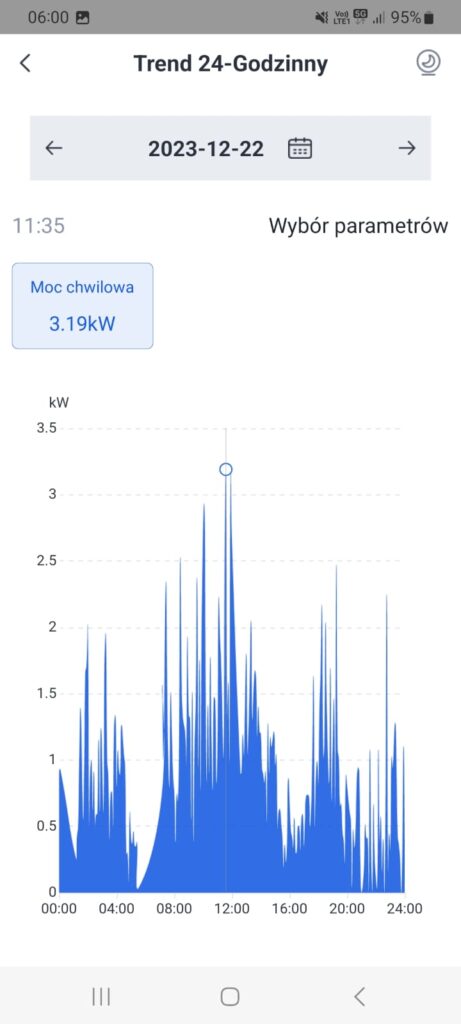
4. Example chart of electricity production from a wind turbine:

5. How is a wind turbine protected against strong winds?
The systems we sell include three safety levels.
1. Turbine design
The turbine structure is asymmetrical and mounted on the mast outside its axis. In addition, the entire body along the tail forms a curved shape.
All of this together causes the turbine, when wind speeds exceed 15 m/s, to turn away from the wind, positioning itself sideways relative to the wind direction.
As a result, the blades rotate more slowly and the turbine produces less electricity, but it moves into a much safer position during strong winds.
2. Controller
During very strong winds, as the rotor speed increases, the turbine generates higher and higher voltage. The increase in voltage is directly proportional to wind speed.
The maximum voltage at wind speeds of around 15 m/s is defined by the turbine manufacturer.
When the controller detects excessively high voltage from the turbine, it activates a braking system in the form of a heating resistor (dump load).
The significant electrical load created by the resistor increases the current drawn from the turbine and slows it down.
Once the turbine speed decreases, the controller switches off the brake, until the voltage or wind speed rises again to a similar level.
3. Inverter (power curve)
Thanks to the power curve programmed into the inverter, the turbine supplies only as much current to the inverter as is allowed.
Most importantly, the inverter ensures that the turbine is not slowed down excessively by drawing too much current.
The same principle applies when the turbine reaches very high production levels. If wind speeds exceed 15 m/s and the turbine begins generating higher voltages, the inverter reacts according to the pre-programmed power curve.
The inverter’s response to excessive wind speed is to increase the current drawn from the turbine, which helps slow it down.
In this way, the rotor speed is reduced and the turbine is protected from overheating.
6. What is the controller used for?
1. AC to DC conversion
It converts the alternating current produced by the turbine into direct current, allowing it to be sent to the inverter. The inverter then processes this energy so it can be stored in the energy storage system, used in the household, or exported to the public grid in case of surplus.
2. Voltage stabilization
The controller reduces the amplitude of voltage fluctuations, ensuring that voltage spikes caused by sudden gusts of wind are as smooth and controlled as possible.
3. Turbine protection against overheating
The controller also protects the turbine from overheating.
If the generated electricity cannot be transferred to the inverter, the turbine may spin faster and faster, and the voltage can rise to as much as 1000 V.
Such high voltage can damage the turbine, leading to electrical breakdowns, short circuits, and eventually burning of electrical components.
This situation may occur when the MPPT gate in the inverter does not open in time and the current has nowhere to flow (string inverters often take several seconds before opening their MPPT gate).
It can also occur when using a standard inverter instead of a hybrid inverter, and a grid outage happens (for example when power lines are damaged by falling trees during strong winds). In such cases, the inverter shuts down.
When this happens, the controller redirects the electricity generated by the turbine to a braking resistor (dump load), slowing down the turbine and protecting it from excessive acceleration.
4. Production monitoring
The controller displays basic turbine production data, including:
- voltage
- current
- generated power.
7. What is important when building a wind power installation?
A wind power installation is much more complex than a photovoltaic installation.
PV panels are mounted on a roof or on the ground, connected to an inverter, and the installation is essentially complete.
A wind turbine, however, first requires a location with good wind conditions. Suitable conditions include open spaces such as fields, areas near water reservoirs, or elevated terrain. The proximity of buildings or forests can cause air turbulence, which disturbs the airflow.
Good wind quality means that the air mass flows as smoothly and consistently as possible, rather than being turbulent and coming from multiple directions.
The second important element is the mast, which must be extremely rigid.
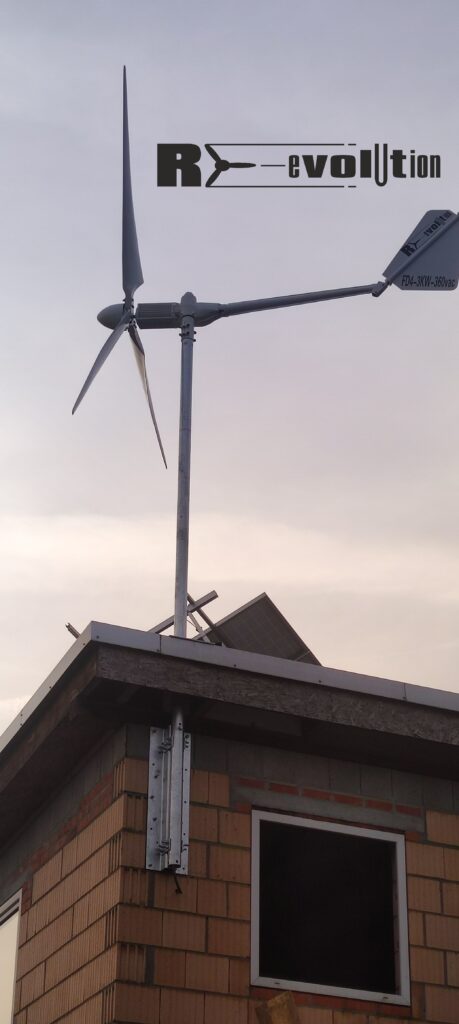
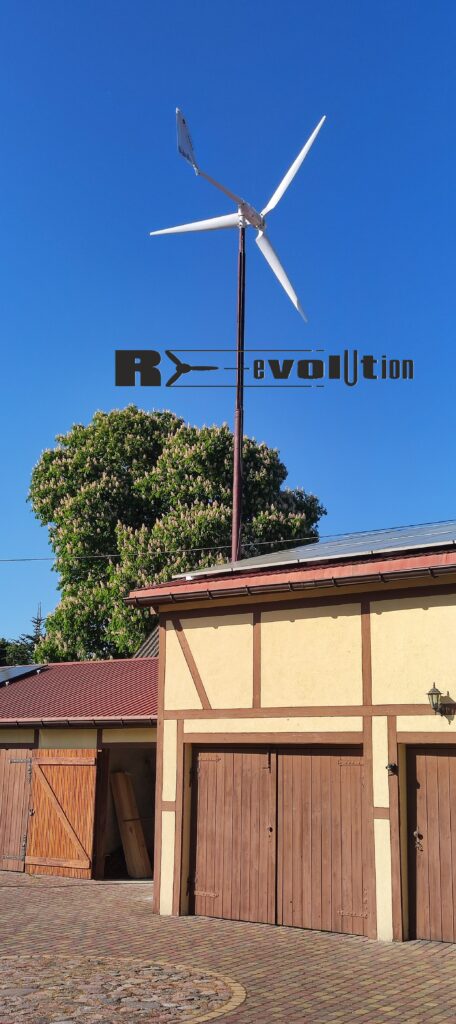
The Re-Evolution 3 kW turbine is the largest turbine that can be installed on a building. It is mounted on a mast attached to the building itself — for example to a solid chimney, a reinforced gable wall, or embedded into the structure near the roof ridge.
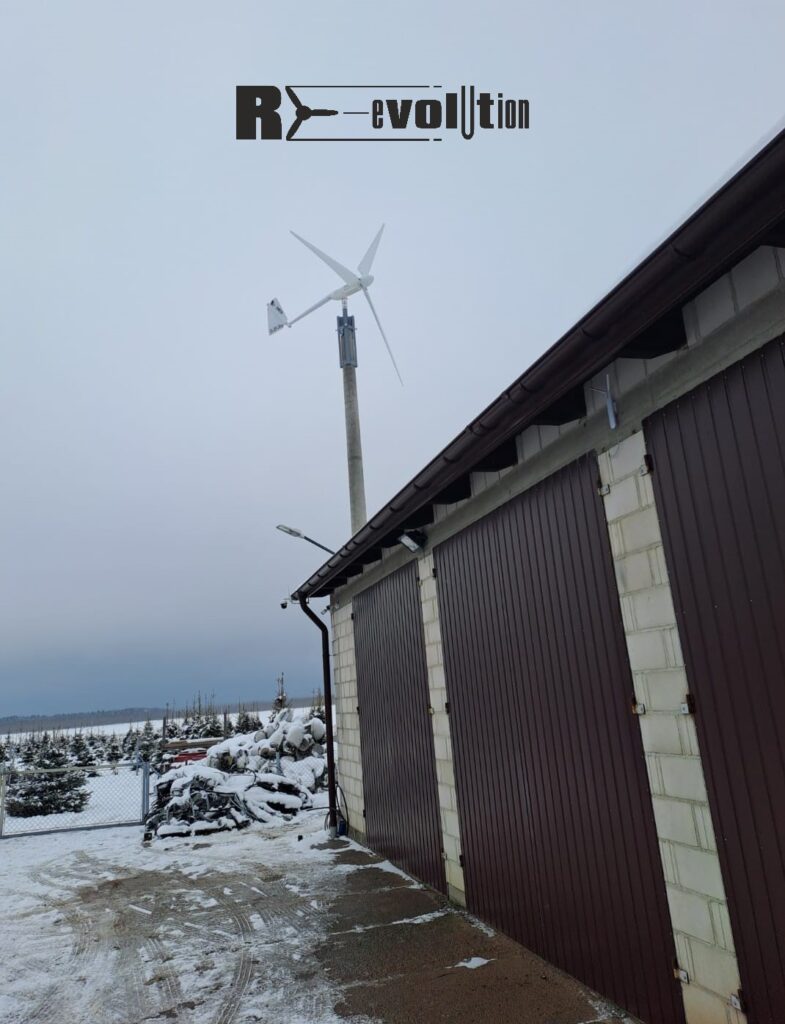
Another method of installing this turbine within the building structure is to install an energy pole-type mast next to the building. The pole is equipped with a special adapter (“cap”) that connects the pole to the turbine.
You can find the design and cross-sections of masts and adapters on our website.
The pole is made of reinforced steel and concrete. The mast we propose is made of two layers of steel with a total thickness of 9 mm.
Once all these elements are in place, the turbine can be installed and connected to the controller, and then to the inverter.
The inverter is another very important aspect. Key factors include:
the speed of MPPT gate activation
the voltage at which the MPPT gate opens
the correctly implemented power curve for the specific turbine
When all these factors are properly configured, you can enjoy electricity production mainly from October to March, when the turbine generates around 70% of its annual energy output.
8. What mast should be chosen for a wind power installation?
Rigid – and this is where the explanation could end, but how do we achieve a rigid mast?
A lack of rigidity in a mast on which the turbine “dances” will sooner or later result in damaged turbine bearings – worn out, cracked, or displaced from their mounting.
To prevent this, we use solutions we have developed ourselves: a mast attached to the building or an installed utility pole with a strength rating of 6 or 10 kN.
Why is this so important?
Because the blades of the Re-Evolution turbine (4 m diameter), at a wind speed of 12 m/s, will receive an air mass that exerts a force of about 160 kg on the turbine mounting point.
This is equivalent to two large men running into the mast and stopping against it.
For a 5 kW turbine, this load increases to 350 kg.
These are enormous stresses. You can observe them during strong winds when a reinforced utility pole weighing over 2 tons begins to vibrate — something that can not only be felt but also clearly seen.
For this reason, when installing a building-mounted mast, we place a 5 mm thick rubber plate between the mounting plate and the wall in order to absorb and dampen vibrations.
9. Which wind turbine is the best?
On the market, two main types of wind turbines dominate: horizontal-axis and vertical-axis turbines.
The efficiency of a horizontal-axis turbine is about 42%, while a vertical-axis turbine reaches only around 16%.
Why is there such a large difference?
The explanation is very simple. In a vertical turbine, when one blade is pushed by the wind, the other blade is moving against the wind. There is probably no need to add much more to understand the efficiency loss.
In general, it is best to follow the design of large industrial wind turbines, because thousands of engineering hours have been invested in developing them.
A horizontal turbine typically has three blades shaped similarly to those used in industrial turbines, which ensures high efficiency.
Another important question is whether the turbine is on-grid or off-grid.
Off-grid turbines are usually low-voltage systems connected directly to energy storage batteries. For example, a 48 V turbine with a power of 2 kW may carry currents of up to 50 amps.
These are very high currents, which require thick cables capable of carrying such loads, proper cooling, and heavy components. This leads to a large and complicated system with many technical challenges.
That is why it is often better to consider on-grid turbines, which are connected to an inverter and then to the electrical grid.
Re-Evolution turbines operate at 360 V, where the current is approximately 10 amps.
Higher voltage means lower current, lower losses, and less heat generation.
Another important factor is the weight of the turbine.
Here the rule is simple: the heavier, the better – similar to batteries.
There are products on some popular Chinese marketplaces where a 5 kW turbine weighs only 31 kg because it is largely made of plastic.
In contrast, a Re-Evolution 5 kW turbine weighs about 350 kg.
Why?
Because it contains a large amount of copper windings, a solid rotor, and a cast-iron housing designed to dissipate heat efficiently and prevent overheating in extreme conditions that will inevitably occur at some point.
For comparison, the Re-Evolution 3 kW turbine weighs 98 kg.
10. How to determine the wind potential of your location?
If we were to do it with at least a minimum level of professionalism, it would take about one year. That is how long wind measurements usually take before building industrial wind turbines.
In our opinion, the first positive sign for someone considering a residential wind turbine is the presence of large industrial wind turbines nearby. However, it should be remembered that those large turbines collect wind at about 100 meters above ground, while a residential turbine typically operates at around 10 meters. At 100 meters, wind speeds can be twice as strong.
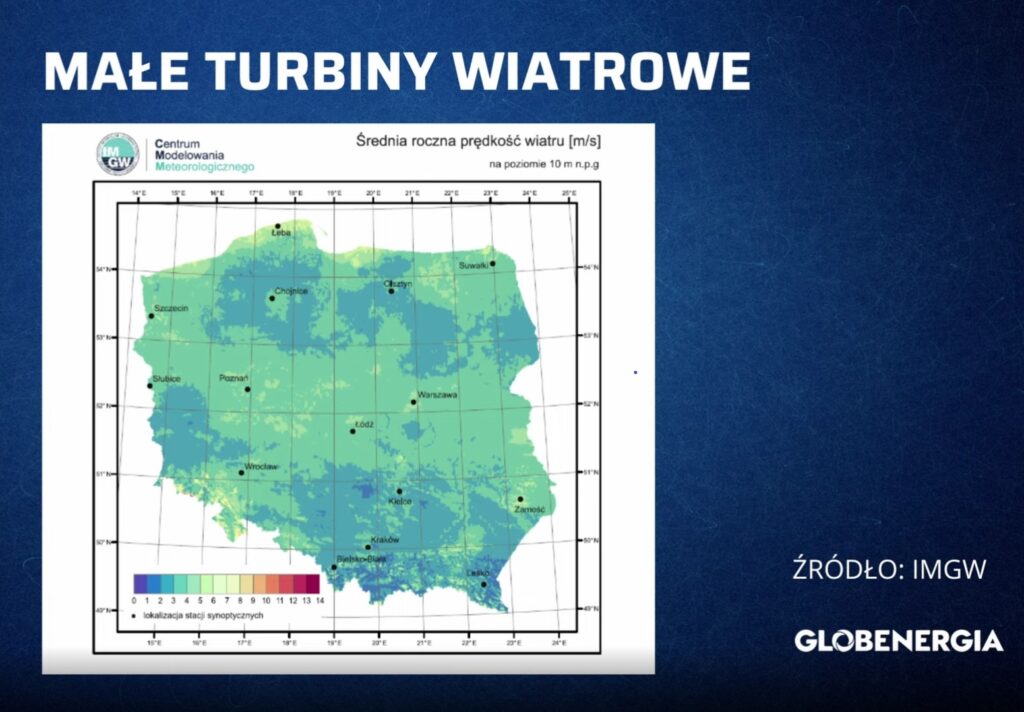
A very general way to estimate wind conditions is by looking at wind maps of Poland. This can be a good starting point when considering whether such an investment makes sense. A wind map for Poland at a height of 10 meters is presented below.
If you expect that your location may be relatively windy, we recommend measuring the wind using an anemometer. Wind meters can be purchased for prices ranging from about 100 PLN to 10,000 PLN.
However, we recommend the following options:
Weather station with an anemometer – GoGEN ME 3900 WiFi
Very accurate measurements every 5 minutes, with charts, history, and statistics.
(Cost from about 619 PLN.)Ultrasonic anemometer, for example from Netatmo.
This is one of the best types of anemometers — highly accurate, capable of real-time readings and generating detailed charts.
However, the cost is above 1000 PLN.
Our subjective feeling of windiness can be misleading. Using an anemometer may therefore be necessary.
Wind quality is very important. Humans usually feel wind gusts, but what we are interested in is steady wind with consistent strength.
Such wind conditions typically occur in open areas or on elevated terrain. The proximity of forests or buildings disturbs airflow, creating gusty and irregular wind.
Accurately estimating future energy production is very difficult without proper measurements.
In open terrain, a 3 kW wind turbine should produce at least 1 MWh of energy per year, but everything depends on local conditions.
In coastal regions, a turbine may produce even 9 MWh per year.
In general, energy production depends on the number of windy days and the overall quality of the wind.
Another helpful tool for estimating wind potential in your area is the Global Wind Atlas: – https://globalwindatlas.info/
11. How to install a pole intended for mounting a wind turbine?
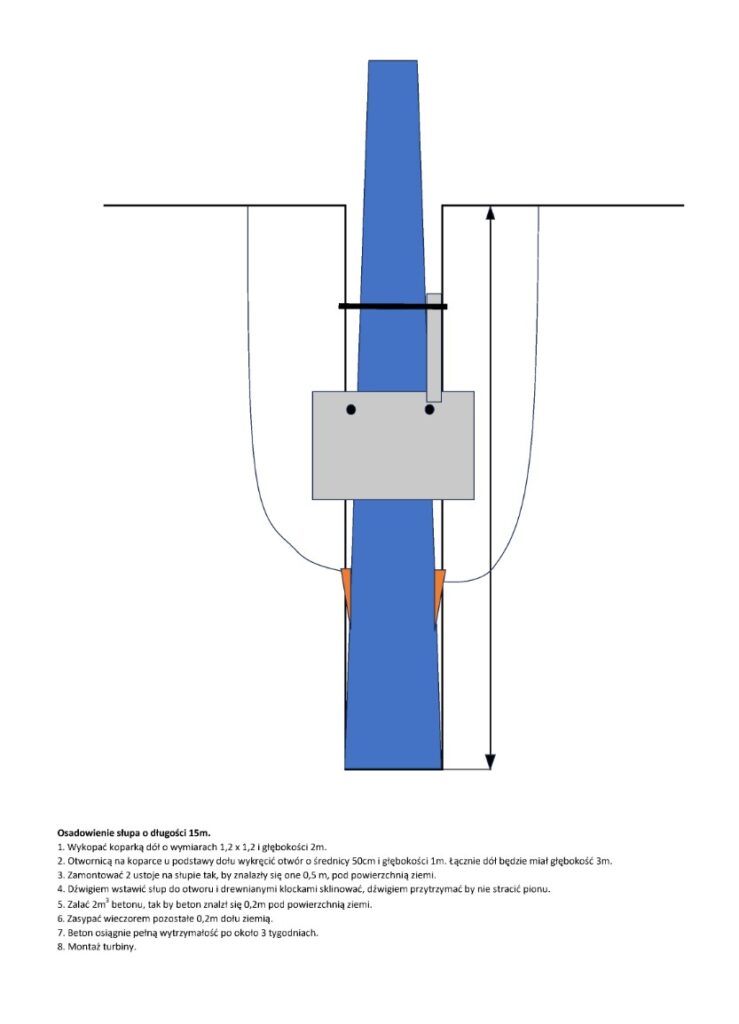
Currently, the cheapest spun concrete utility poles can be purchased on the website: https://elzakup.pl/
These spun concrete poles (E-type) are commonly used as supports for overhead power lines and other structures, thanks to their high strength, durability, and long service life.
12. How to determine the quality and suitability of wind for a wind turbine.
Many people consider generating energy from wind when they feel that their location is constantly windy. Unfortunately, this is a subjective feeling, experienced only physically. Wind cannot be seen, which makes it difficult to determine its actual strength, direction, and especially its quality and stability based only on personal perception.
An anemometer can answer some of these questions, but usually only approximately. This is because most anemometers costing up to about €200–€250 (around 1,000 PLN) collect data only once every five minutes.
With such a dynamic natural phenomenon as wind, this is far too infrequent. Wind conditions — including direction, strength, and stability — can change every few seconds. With measurements taken only once every 300 seconds, the data we obtain is very superficial.
Wind speed is only one of the parameters needed to evaluate the energy potential of a location. Another — and perhaps the most important — factor is stability and consistent wind direction.
A horizontal-axis wind turbine requires linear, consistent wind flowing in one direction. Otherwise, even if strong gusts occur but come from different directions, the turbine will spend its time searching for the wind direction (“yawing”) instead of producing electricity.
A horizontal turbine installed at a height of 10–12 meters requires stable, directional wind in order to generate energy effectively.
So how can we check, in an inexpensive way, whether such wind conditions exist on our property?
First of all, these types of winds occur mainly in open areas. There should be no tall trees or buildings nearby, because they disturb airflow by deflecting wind currents.
This causes the wind to become turbulent, irregular, and short-lived, even if the gusts feel strong. To a person standing there it may seem that the wind is constantly strong, but this impression can be misleading.
It is important to understand that a tree with a height of 20 meters can disturb airflow for a distance of up to 200 meters behind it.
This means that only about 200 meters beyond such an obstacle does the wind flow become stable again.
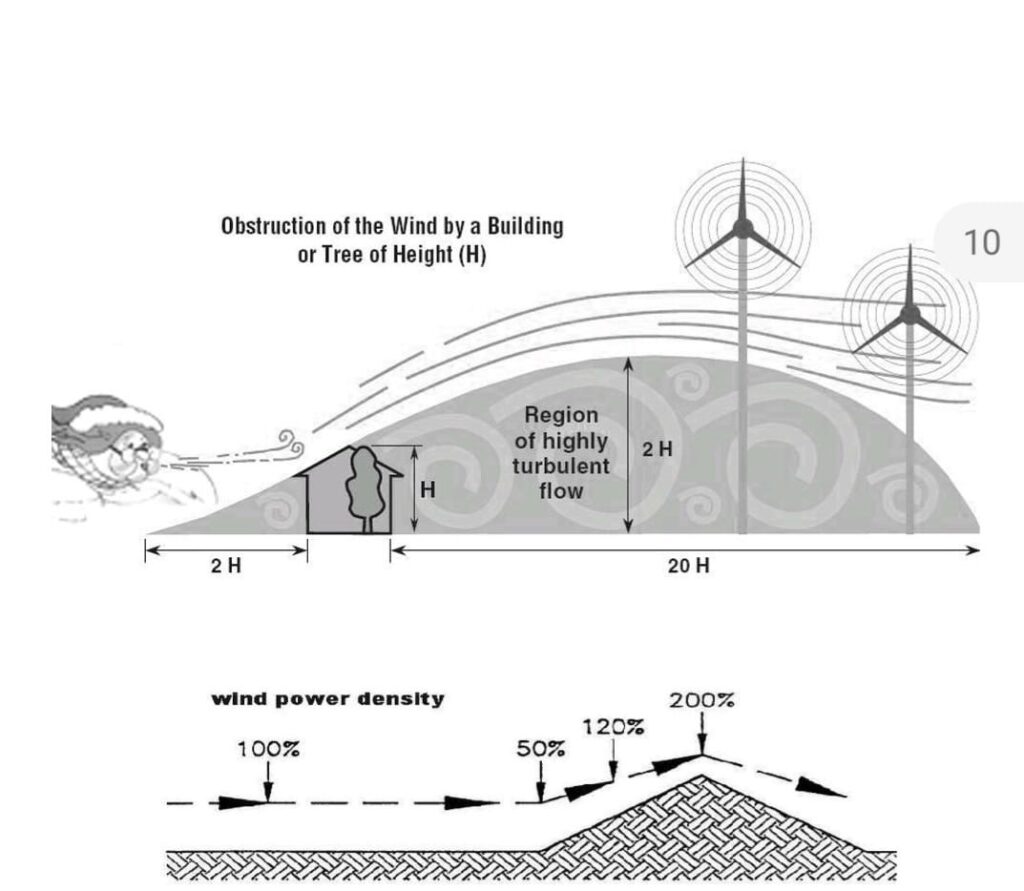
It is also worth noting that a standard anemometer is essentially a small vertical wind turbine. Such a design collects all types of wind — both useful and turbulent — from every direction and at any moment.
Because of this, the data collected in this way may not be very useful when evaluating conditions for a horizontal wind turbine.
A better solution is ultrasonic anemometers. Unfortunately, they are much more expensive, and it is also important that the data they provide is recorded not once every five minutes, but at least once every five seconds. Only such detailed measurements provide data that is truly useful for making proper decisions.
Is there another way?
Yes — and it costs only a few dozen złoty, plus some patience and time for observation.
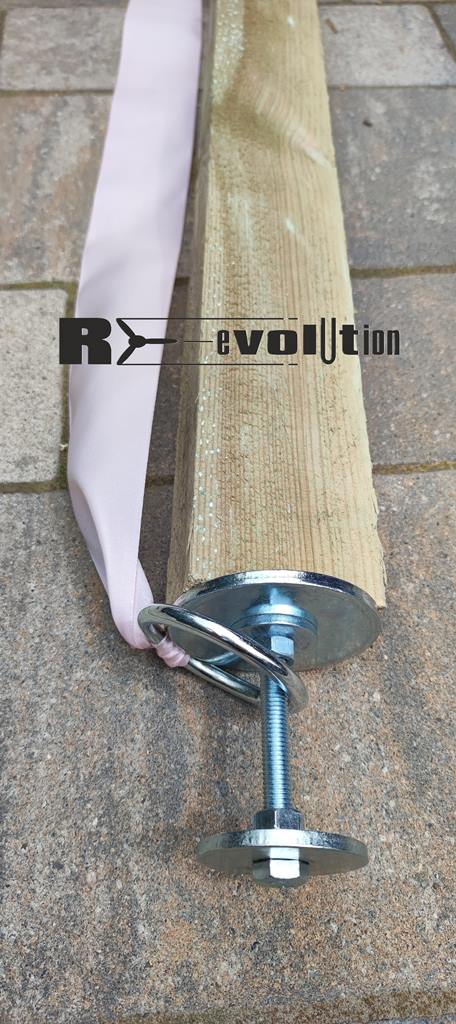
At the location where you plan to install the wind turbine, place a pole (wooden or metal). Attach a ribbon about 2 meters long and 5 cm wide to the top of the pole. An example of such a setup is shown in the photo.
The observation process involves watching how often the ribbon changes direction and how long it remains lifted by the wind.
If the ribbon frequently changes direction, often falls down and then rises again, it indicates that the wind is turbulent and inconsistent. Such a location is not suitable for installing a horizontal-axis wind turbine.
A vertical turbine might capture some of that wind, but a horizontal turbine in such conditions would spend most of its time searching for wind direction — just like the ribbon — instead of producing electricity.
However, if the ribbon blows consistently in one direction for periods of at least one minute, remaining steadily lifted by the wind, then installing a turbine may be worth considering.
At that point, it is advisable to measure the wind speed and the number of hours during which such wind conditions occur.


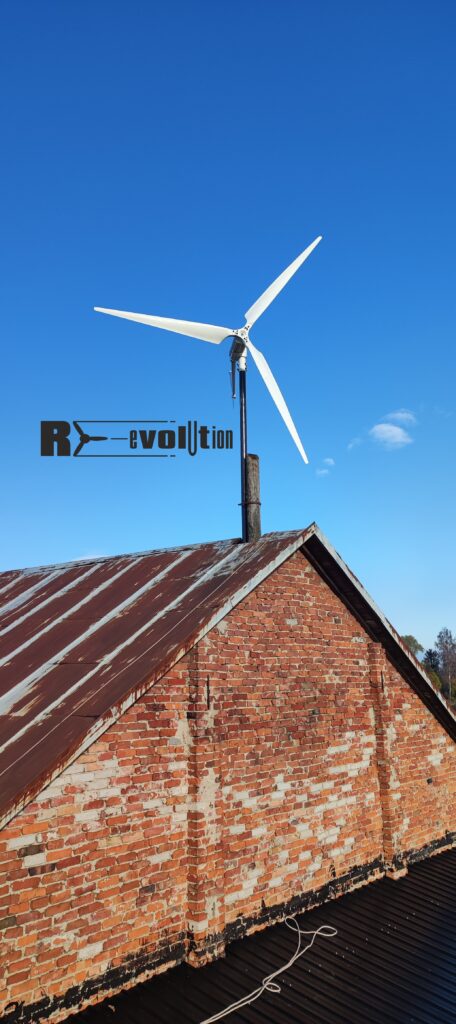
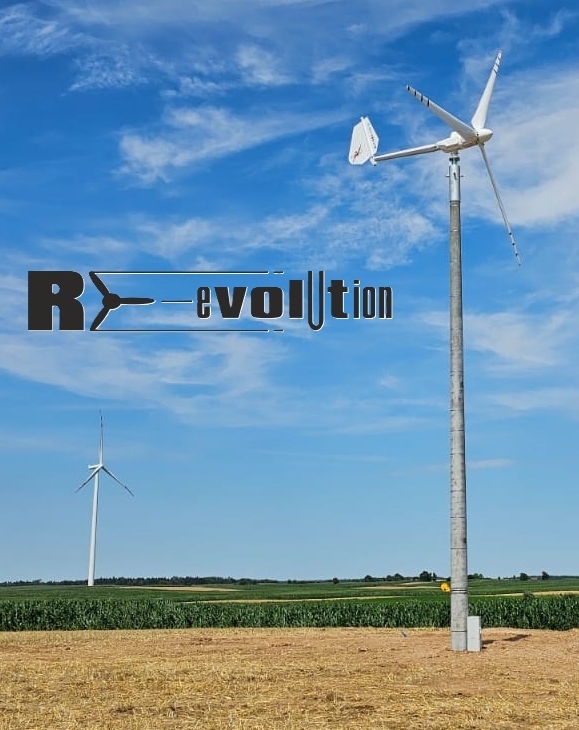
13. What does a properly functioning wind turbine look like when generating electricity in the wind?
14. Subsidies for a wind power installation
Currently in Poland there is a government program supporting the installation of residential wind turbines called “Moja Elektrownia Wiatrowa” (My Wind Power Plant).
The program is intended for owners or co-owners of single-family houses, who want to install a small wind turbine to produce electricity for their own needs.
Amount of subsidy
Under the program you can receive:
up to 50% of eligible investment costs
maximum 30,000 PLN for a wind turbine installation
up to 17,000 PLN for an energy storage system (battery)
In total, support for a turbine together with an energy storage system can reach about 47,000 PLN.
Conditions for the subsidy
The main requirements include:
the wind turbine must have a capacity between 1 kW and 20 kW
the installation must be new and legally installed
the energy produced must be used primarily for the household’s own consumption
Budget of the program
The total budget of the program is about 400 million PLN, financed from the EU Modernisation Fund.
Application process
Applications are submitted online through the NFOŚiGW application generator, and subsidies are granted as a reimbursement after the installation is completed and launched.
15. Wind Turbines – 2 Years of Experience
In May, it will be two years since the installation of the first residential wind turbine. We have sold well over 100 turbines, installed throughout Poland, and some of them remain under our supervision. Here are 10 conclusions drawn from our experience.
1. Residential wind turbines are the most unpredictable source of electricity.
The source of energy is wind, which we cannot see, and our perception of it is highly subjective.
2. For a horizontal turbine to produce electricity, it must be installed in a location with steady, one-directional wind that is not turbulent.
These must be open areas without nearby buildings or trees relative to the rotor axis. All such obstacles disturb the natural airflow.
3. A turbine installed on a pole produces about 40% more energy than one mounted on a building.
The reason is the proximity of the building to the blades. Wind reflecting off the building disturbs the airflow reaching the turbine.
4. Everyone asks: HOW MUCH? How much electricity will a turbine produce in a year?
A 3 kW turbine in a good location on a pole can produce 1,000–1,500 kWh per year.
A 5 kW turbine can produce around 2,000 kWh.
However, many factors influence the final output.
5. Location on the map of Poland.
There are no strict rules — local conditions are crucial. Turbines installed on the same property may produce different results. Our observations show that mountain foothill areas are the most risky, because airflow over hills is highly turbulent due to terrain, trees, and local pressure variations.
The most reliable locations include lake shores exposed to wind, hilltops, and open fields.
6. A wind turbine should not be the primary source of electricity.
A turbine generates power only when wind speed exceeds 3 m/s, and sometimes such wind may not occur for two or three weeks.
However, the sun shines every day. Therefore, turbines make the most sense as part of a hybrid energy system:
PV panels + wind turbine + energy storage + grid power
A hybrid inverter manages these sources so that the household purchases as little electricity as possible from the grid.
7. Is installing a wind turbine economically reasonable?
This is the most difficult question to answer. If the turbine is installed correctly, purchased at a reasonable price, supported by the “My Wind Power Plant” subsidy program, located in a suitable area, and mounted on a pole, then the answer is yes.
However, all these factors must occur simultaneously.
When calculating economic efficiency, one should consider not only the electricity produced by the turbine, but also the benefits of energy management through the inverter and especially energy storage.
8. What is a reasonable price for a wind power system with energy storage?
Assuming:
3–4 kW turbine on a pole, controller with brake, DEYE 12 kW inverter with bypass, 10 kWh energy storage → about 55,000–60,000 PLN
5 kW turbine on a pole, controller with brake, DEYE 12 kW inverter with bypass, 14 kWh energy storage → about 73,000–75,000 PLN
7.5 kW turbine on a pole, controller with brake, DEYE 12 kW inverter with bypass, 14 kWh energy storage → about 83,000–85,000 PLN
The price may be higher if, for example, the distance between the turbine and inverter is large, or if the electrical installation in the building must be upgraded or extended.
9. What should be avoided when installing a turbine?
installing it on a building where people sleep
installing it on weak walls that are not reinforced, or on a chimney
using a weak mast that bends under the weight of the turbine
equipment servicing the turbine should be installed as close as possible to the main electrical distribution board inside the building
10. Can it be done cheaper?
Theoretically yes — but is it worth it?
We build installations based on the DEYE hybrid inverter, which acts as a computer managing the household energy system. The functionality of this device is extensive, and its purpose is to minimize the purchase of electricity from external sources.
In our opinion, building systems on weak, non-galvanized masts, with installations lacking full functionality, or using controllers that cannot properly brake the turbine, will ultimately affect the real costs and benefits in the future.
All of this should serve our comfort, independence, and safety, especially in situations such as power outages.
16. What determines the power of a wind turbine?
Of course, it depends on the generator winding used in the turbine.
But that explanation is too simple. It also depends on the wire used, its diameter, resistance, the number of magnetic poles, mechanical losses, and most importantly the blades.
The blades act like a sail that drives the turbine.
But that is still not everything. The efficiency of a turbine also depends on air density, temperature, pressure, and humidity, not to mention the most important factor — whether the wind is stable and coming from one direction.
In total, there are nearly 20 variables that influence the performance of a wind turbine.
So what can a wind turbine buyer actually influence?
Certainly the choice of turbine itself, the blades, and where and how the turbine is installed.
We will skip the generator itself and focus on the blades. They vary in quality, shape, and material, such as:
carbon fiber
fiberglass
plastic
aluminum
wood
So how much power can we theoretically obtain from turbine blades?
There is a formula for that:
P = 0.5 · ρ · A · v³ · Cp
Where:
ρ — air density (about 1.225 kg/m³ at sea level under standard conditions)
A — swept area of the blades = π · R², where R is the blade radius
v — wind speed (m/s)
Cp — turbine power coefficient (0 < Cp ≤ Betz limit 0.593, in practice often around 0.3–0.5)
Since most of Poland lies at an altitude of 50–200 meters above sea level, we can assume an air density of 1.2 kg/m³.
Our 3000 W wind turbines have blades with a radius of 1.95 m.
Let us assume a power coefficient Cp = 0.4.
Based on the calculation, we obtain a theoretical output of 4954 W at a wind speed of 12 m/s.
This result may seem surprisingly high, but it would only occur under laboratory conditions, which rarely exist in reality. In real-world conditions we must also consider:
the quality of the generator winding
blade quality
bearing friction
electrical losses during power collection
air pressure
temperature
Nevertheless, this 3000 W turbine installed near Iława actually reached a maximum peak power of 4920 W under real conditions. Unfortunately, the exact wind speed at that moment is unknown.
A very important fact that the average person often does not realize is that power output from turbine blades does not increase linearly with wind speed — it increases with the cube of wind speed.
This creates huge differences. For example:
If a manufacturer specifies that a turbine reaches 3000 W at a wind speed of 12 m/s, then at 11 m/s the power output will be only about 2310 W.
The calculations illustrating this relationship are shown in the table below.

The table above can be downloaded in an interactive version from:
However, everything described above is still theoretical, because the natural environment involves around twenty different factors that affect the actual performance of a wind turbine. The most important of them are:
steady wind, allowing the turbine to align with the airflow and rotate its blades smoothly, which supports stable electricity generation
consistent wind direction, so the turbine does not constantly rotate on the mast but instead keeps spinning its blades steadily. Every change in wind direction causes the generator to slow down, reposition itself toward the new direction, and then accelerate again with the next gust.
Because of this, many people who want to determine whether a wind turbine is suitable for their location try to measure wind using an anemometer. They often attempt to correlate turbine output with wind speed and direction based on data from such devices.
However, this can be very misleading, because the operating principles of these two devices are completely different.
First of all, a traditional anemometer is essentially a small vertical wind turbine that collects turbulent winds coming from different directions. At the same time, measurements may be distorted because one blade reacts to a gust of wind while the opposite blade is partially slowed down by that same wind.
Another important factor is the weight and sensitivity of the devices.
A traditional anemometer has plastic blades weighing about 10 grams, and its sensitivity operates on the scale of milliseconds.
In contrast, the blades and rotor of a 3000 W wind turbine weigh over 40 kg, and the turbine is additionally slowed by the electrical load drawn by the inverter.
Therefore, when a wind gust occurs, it may take 7–10 seconds for the turbine to reach rotational speed corresponding to that wind strength. During that time, the gust may already weaken, meaning the turbine may never reach the output suggested by the anemometer reading.
So is it possible to determine exactly how much energy a specific turbine with specific blades will produce in a given location?
Only very approximately.
For good performance, the most important factor is placing the turbine in open areas where airflow is not disturbed by buildings or trees. Such disturbances can create turbulence caused by wind reflecting off obstacles.
This can be checked using the simple “ribbon test” described in point 12.
Our conclusion is that blade size is very important, because it directly affects the power output of the generator.
However, it is also important to remember that if the blades are too large relative to the turbine, you may achieve better production during normal wind conditions.
But several times each year in Poland, very strong weather fronts from the Atlantic bring winds that exceed normal levels for about 24 hours. In such conditions, overly large blades may cause the turbine to overheat, which can eventually damage or burn the generator.
It is also possible that excessively large blades may cause aerodynamic stall, meaning the controller may lose the ability to control the turbine properly.
Blade failure is also possible — the tip speed of turbine blades should not exceed approximately 300 km/h.







Contact:
-
Re-evolution Sp. z o.o.
ul. Św. Michała 100/6
61-005 Poznań - +45 50 10 59 72
- contact@re-evolution.pl